Astro Info Service Limited
Information Research Publications Presentations
on the Human Exploration of Space
Established 1982
Incorporation 2003
Company No.4865911
E & OE
Gemini 7
GEMINI 7 MISSION REPORT |
LAUNCH DATA |
|
|
Launch: |
4 December 1965, 19:30:03 UTC |
Launch Site: |
Pad 19, Cape Kennedy, Florida, USA |
Launch Vehicle: |
Titan II Gemini Launch Vehicle No. 7 (GLV-7) |
Spacecraft: |
Spacecraft No. 7 |
Spacecraft Mass: |
Approx. 3,663 kg (8,076 lbs.) |
|
|
MISSION OBJECTIVE |
Demonstrate a two-week mission duration, evaluate the 'shirt-sleeve' environment and lightweight pressure suit and act as a rendezvous target for Gemini 6A |
|
|
CREW DATA |
Crew Position |
Name |
Mission |
Command Pilot |
Frank F. BORMAN II, 37,
US Air Force |
1st |
Pilot |
James A. 'Jim' LOVELL Jr., 37,
US Navy |
1st |
|
|
Flight Crew |
2 |
Call Sign |
Gemini Seven |
Back-up Crew |
Edward H. White II (Command Pilot)
Michael Collins (Pilot) |
EVAs |
None (None planned) |
|
|
|
|
MISSION DATA |
Flight Duration |
13 days 18 hours 35 minutes 1 second |
Distance Travelled |
Approx. 9,030,000 km (5,610,980) miles |
Orbital Data |
299.7 x 303.7 km (186.2 x 188.7 miles) with a period of 90.54 minutes |
Landing |
18 December 1965, 14:05:04 UTC |
|
|
During the early days of human space flight, providing the ability to remain in space for increasing durations was a primary goal for both the American and Soviet programmes. Establishing the capability of long duration space flight would ensure that the hardware, systems and human crews could attain the objectives being set by both nations. For the Americans, the mission of Gemini 7 would address that challenge.
Fourteen-Day Endurance Mission
In the mid 1960s it was estimated that an Apollo mission to the Moon would take up to two weeks, so it was important to build up experience beyond the 36 hours of the longest one-man Mercury mission. The Soviets had surpassed this with solo flights of four and then five days, while the four-day US endurance record of Gemini 4 was soon surpassed by the eight-day mission of Gemini 5. This was the estimated duration for an early lunar landing mission. The 14 days of Gemini 7 in the cramped confines of the two-man spacecraft was an endurance marathon and ranks as one of the most gruelling missions of the 1960s.
Originally, the 14-day mission was going to be Gemini 6, with Gemini 5 attempting rendezvous and docking with the uncrewed Agena, but delays in preparing the hardware changed that plan. The two-week mission was instead assigned to Gemini 7. There would be no rendezvous or docking activities; the objective was clearly to attain the 14-day target and to conduct a range of observations and medical experiments along the way. However, when Gemini 6 was delayed after its Agena target was lost in a launch failure, Gemini 7 was launched first. With no replacement target available, the opportunity arose instead to launch Gemini 6 on a rendezvous mission with Gemini 7, which would already be in space. The schedule was tight and it was a challenge to get the second vehicle ready, on a launch pad that had only recently been vacated by Gemini 7. As plans evolved, there were suggestions that the pilots of the two spacecraft might conduct EVA - even swapping places to return on each other's vehicles - but this was soon abandoned as too risky. The new Gemini 6 mission would be restricted to a brief rendezvous exercise, to ensure that nothing hindered the 14-day Gemini 7 objective.
Two Weeks in the Front Seat of a Volkswagen
With the success of Gemini 4 and 5, confidence was high that the 14-day mission would also be successful. Gemini was roomier than Mercury, but not by much. With two astronauts and their equipment inside and the hatches closed, the crew compartment was always going to be cramped. As a result, the media soon picked up on the idea of the two astronauts spending a fortnight in what could be compared to the front seats of a small family saloon car. To alleviate the problem, NASA provided a lightweight spacesuit, which could be partially removed to relieve discomfort during the mission as there were no EVAs planned. For safety, only one of the astronauts would be unsuited at any one time during the mission. Taking turns getting out of and then back into the suits provided an additional challenge for the two astronauts.
"We're on our way Frank"
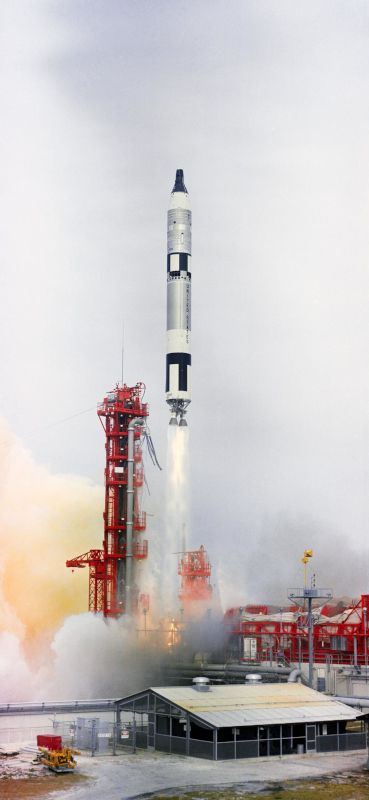
These words from Pilot Jim Lovell were scarcely necessary, as it was obvious that the mission was underway from the noise of the engines and the vibrations through the Titan rocket as it soared off the pad, lifting the heaviest Gemini in the programme into orbit for the next two weeks. The two astronauts had talked extensively to the crews of Gemini 4 (to whom they had served as back-ups) and Gemini 5 about the challenges of their orbital adventures. Crew compatibility was imperative for the Gemini programme to succeed and Deke Slayton, the Director of Flight Crew Operations who chose the crews, later wrote that he had pencilled Borman in for one of the longer missions for some time, because of his tenacity. He also reasoned that Lovell was "a very capable guy you could have assigned to any mission, [which] was a big help [on Gemini 7]."
Settling in
One of the earliest tasks upon entering orbit was to turn the spacecraft around and try to keep station with the spent upper stage of their booster. They were able to do so for 15 minutes, until it became clear that the stage was moving erratically and venting fuel. Borman was also concerned that he was using too much of his spacecraft's fuel in the exercise, but it was a useful experiment on the path to more complicated rendezvous operations on later missions. The spacecraft generally performed well for most of the mission, but towards the end of the flight a problem with a thruster and the failure of a fuel cell increased the time they spent drifting and necessitated limited use of the spacecraft's batteries for power.
Experiments and Observations
Fourteen of the 20 experiments flown on Gemini 7 were re-flights of earlier experiments, while the other six were new investigations. Naturally, given the long flight, many of the experiments centred upon medical evaluations, while others focused upon observation and navigational development.
The medical experiments included the requirement to collect and save some of their bodily waste for post-flight analysis, a chore which both astronauts reported was one of the less enjoyable aspects of their mission. Urine collection was particularly difficult and unpleasant, resulting in the crew suggesting the additon of a tube and valve mechanism to release the fluid out into space. This was later incorporated into the Apollo Command Module. Recording every use of drinking water was also a pointless exercise according to the astronauts, who stated that the water hose gauge could record the amount of water used more easily.
Observations of the Earth, its atmosphere and the stellar background were also undertaken on the mission. During their 31st orbit, the astronauts observed the underwater launch of a Polaris missile from the submarine USS Benjamin Franklin off the coast of Florida.
Living Aboard Gemini
The habitability of the spacecraft was one of the most interesting aspects of the mission, with important application to far longer flights in the future. Borman and Lovell's working day was timed to that of Houston, with both astronauts sleeping simultaneously. They had practiced waste stowage and housekeeping to ensure that the environment was as pleasant as possible, while for two weeks prior to the mission they had showered using an anti-dandruff shampoo to reduce the chance of dry skin flakes floating around the cabin, though in practice this made little difference. Wearing the pressure suits seemed to prevent skin drying, while sanitary wipes helped to alleviate unpleasant smells until the storage bins that held the waste were opened. The food was adequate and palatable but lacked variety, with juices and puddings the favourite and the dehydrated food rated as far better tasting than the bite-sized selections.
For the first part of the mission, Borman suffered the discomfort of continually wearing his spacesuit, while Lovell was able to leave his off. Later in the mission, they swapped over. As one of the larger astronauts, Lovell had some difficulty getting in and out of his suit, despite the inclusion of zippers and the lightweight material of the suit. Management relented towards the end of the mission, realising there was little point in having wither astronaut suited, easing their comfort and mobility aboard the spacecraft.
Contact with Earth was essential during the mission, with regular news and sports reports read up to the crew. In one report they were told that two commercial jets had collided near New York but had landed safely with few casualties. Borman commented that they seemed to be a lot safer up alone in orbit, but Lovell gently reminded his commander: "We're not down yet, Frank!"
On their eight-day mission, the crew of Gemini 5 had become tired and bored, so more experiments were assigned to the 14-day flight of Gemini 7. A couple of paperback books with no connection to the space programme were also authorised for flight. Borman chose Mark Twain's Roughing it, a story about a 19th Century journey, while Lovell chose Walter Edmonds' novel Drums Along the Mohawk about the 18th Century wars with Native Americans. With little time to read on the mission, neither astronaut finished their book
Welcome Visitors
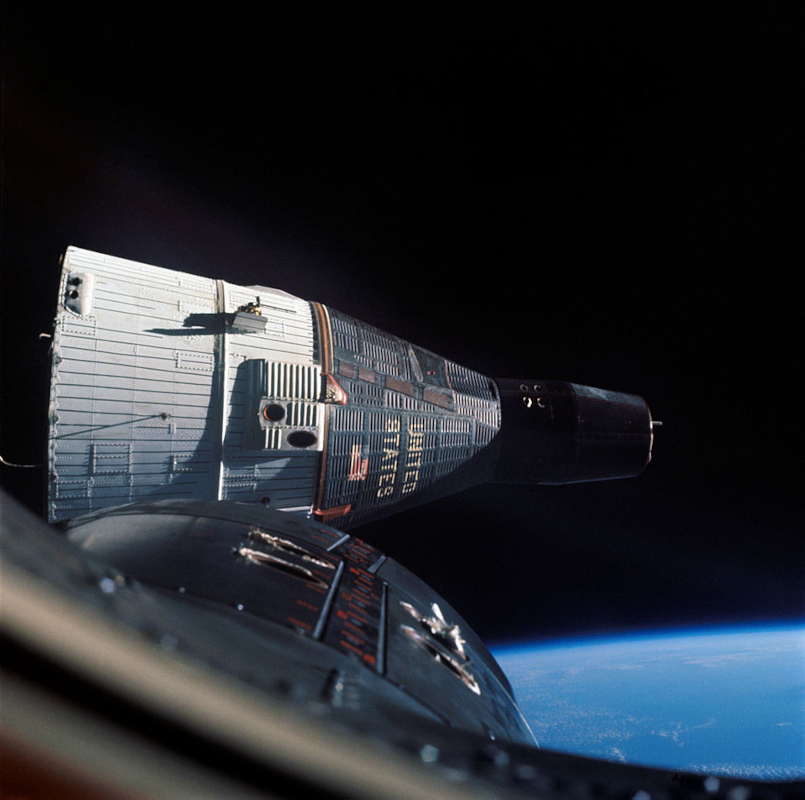
Gemini 6 was launched on 15 December, the 11th day in space for Gemini 7. The historic space rendezvous occurred on the fourth orbit of Gemini 6, five hours after the mission was launched. Gemini 7 acted as the passive target as Gemini 6 astronauts Wally Schirra and Tom Stafford brought their spacecraft to within 0.3 m (1 ft) of Borman and Lovell in Gemini 7. For 270 minutes, the two crews chatted to each other over the radio, displayed signs in their windows and photographed each other's spacecraft. With their rendezvous completed, the two spacecraft moved several miles apart to avoid the possibility of collision while the crews slept.
End in Sight
Gemini 6 landed the following day, but Borman and Lovell still had three days to go, with the novelty of space flight by now wearing thin as they drifted around the planet every 90 minutes. According to Borman, this part of their mission was "bad". Finally, on the 14th day of the mission, the two astronauts brought Gemini 7 home, splashing down just 12 km (6.4 nautical miles) from the planned landing point. Though somewhat exhausted by their gruelling mission, both men were in good health and soon recovered.
Gemini 7's duration record lasted until the 18-day flight of Soyuz 9 in June 1970 and it retained the American record until the 28-day flight of Skylab 2 in June 1973. Gemini 7 remains one of the longest American space missions that did not dock with a space station.
After Gemini 7
Following the flight, Frank Borman moved across to Apollo to take command of an early crew. Jim Lovell remained with Gemini and commanded the final mission of the series, Gemini 12, in November 1966. He then also moved over to Apollo. A consequence of the 1967 Apollo 1 pad fire and subsequent crew reassignments saw the two astronauts team up again to fly Apollo 8 around the Moon in December 1968, together with Bill Anders. Borman left NASA shortly after that mission, but Lovell stayed on to command the ill-fated Apollo 13 aborted lunar landing mission in April 1970 before he, too, retired from NASA.
This mission report is copyright Astro Info Service Limited, 2015, 2026
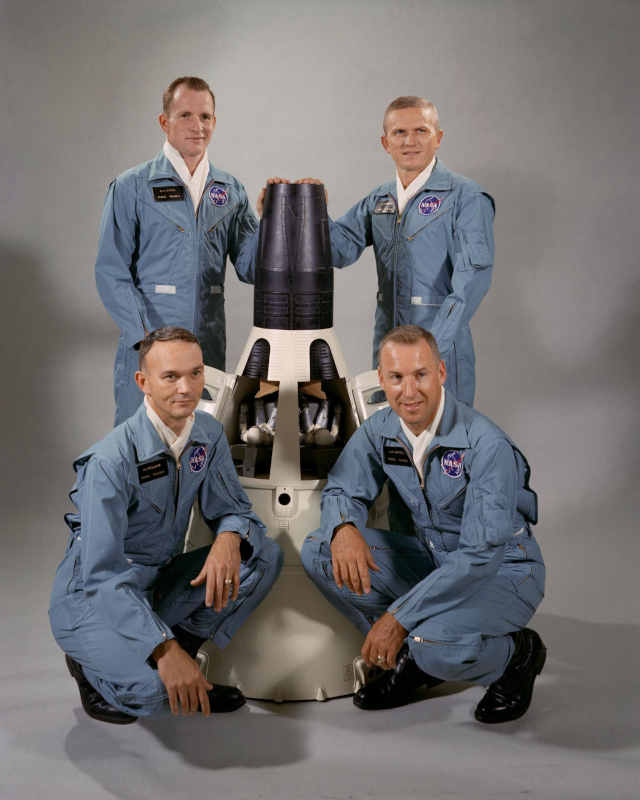
Portrait of the prime and back-up crews of Gemini 7 posing around a model of the spacecraft. The Prime crew of Command Pilot Frank Borman (standing) and Pilot Jim Lovell (kneeling) are on the right, with the Back-up crew of Command Pilot Ed White (standing) and Pilot Mike Collins (kneeling) on the left.
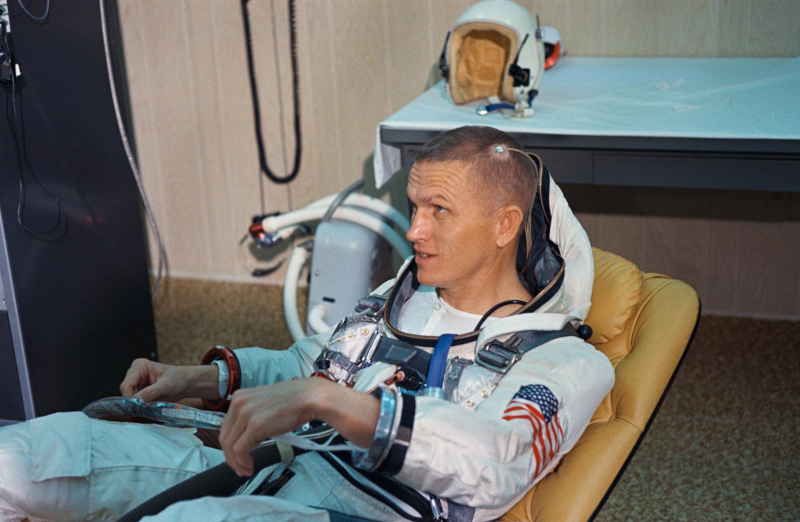
Command Pilot Frank Borman undergoing suiting up operations prior to the launch of Gemini 7. Note the medical biosensor attached to his scalp. This was used to measure the electrical activity of the cerebral cortex during periods of weightlessness, to assess alertness, levels of consciousness and depth of sleep.
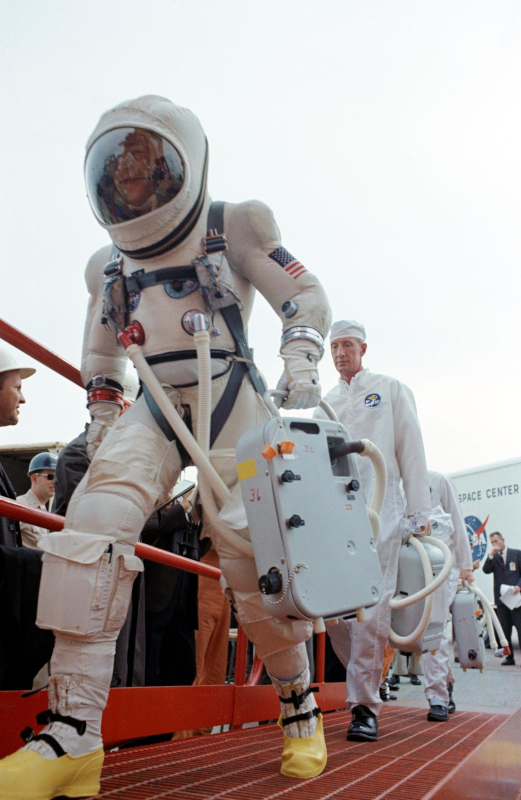
Pilot Jim Lovell walks up the ramp to the elevator at Pad 19, KSC. The elevator would take the two astronauts up to the White Room at the top of the launch tower, where they would be inserted into the spacecraft.
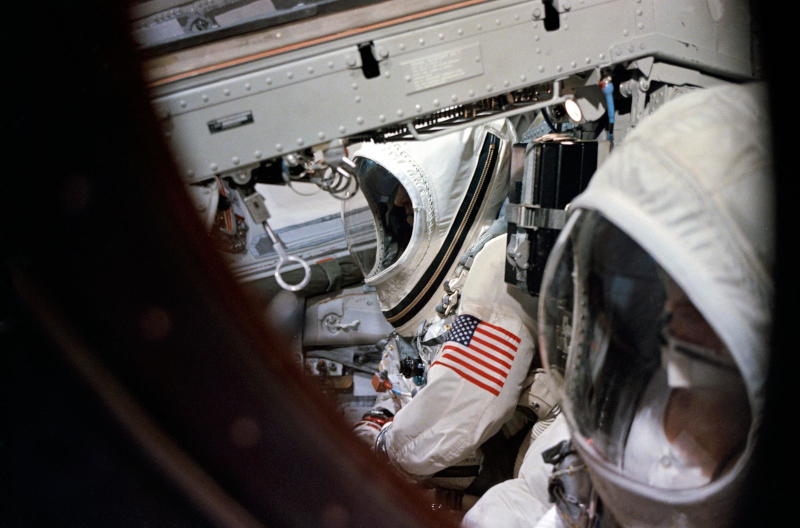
Borman (nearest camera) and Lovell are sealed inside the spacecraft 75 minutes prior to launch. This image gives some idea of the close confines the two men would endure on orbit for the next 14 days
"We're on our way, Frank!" The launch of Gemini 7, on 4 December 1965, and the start of "two weeks in the front seats of a VW" for the two astronauts.
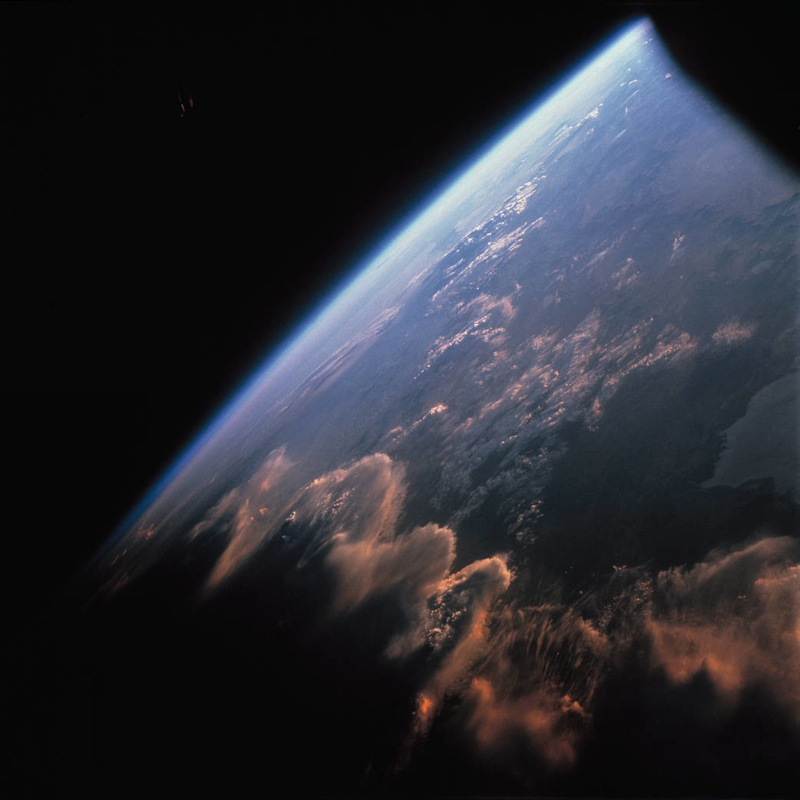
This view of Earth taken from Gemini 7 looks south across the Andes mountains from northern Bolivia. The orange glow of the clouds is due to the low angle of the sun to the west. The dark area to the left is the Earth's terminator line, separating day and night.
The historic rendezvous with Gemini 6 occurred eleven days into the Gemini 7 mission. This image shows the Gemini 7 spacecraft in orbit, taken by the crew of Gemini 6 during the rendezvous approximately 257 km (160 miles) above the planet.
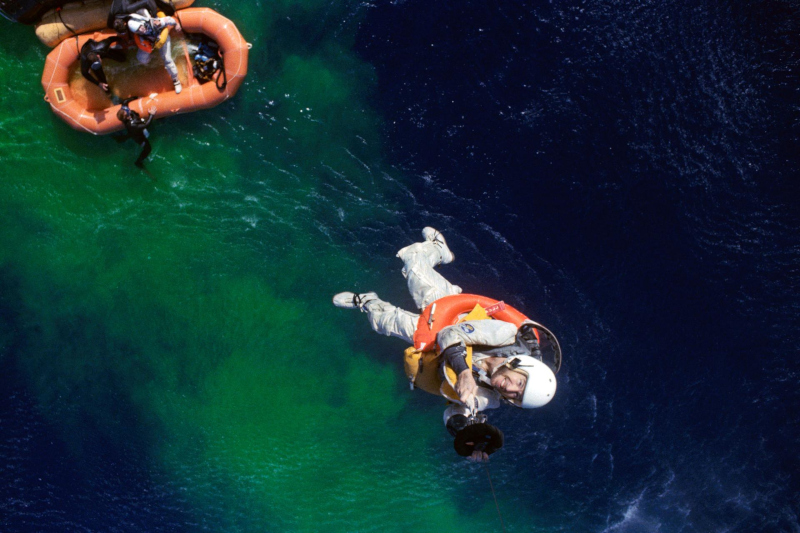
Pilot Jim Lovell is winched aboard the recovery helicopter from the USS Wasp shortly after Gemini 7 splashed down in the Atlantic on 18 December 1965. Three navy divers remain in the life raft near the space capsule with Command Pilot Frank Borman as he awaits his turn.