Astro Info Service Limited
Information Research Publications Presentations
on the Human Exploration of Space
Established 1982
Incorporation 2003
Company No.4865911
E & OE
Apollo 7
APOLLO 7 MISSION REPORT |
LAUNCH DATA |
|
|
Launch |
11 October 1968, 15:02:45 UTC |
Launch Site |
Pad 34, Kennedy Space Center, Florida, USA |
Launch Vehicle |
Saturn 1B (SA-205) |
Spacecraft |
CSM 101 |
Spacecraft Mass |
Approx 16,519 kg (36,419 lbs) |
|
|
MISSION OBJECTIVE |
The first crewed Apollo (CSM only) mission, designed to demonstrate the performance of the spacecraft and support facilities with a crew in Earth orbit |
|
|
CREW DATA |
Crew Position |
Name |
Mission |
Commander |
Walter M. 'Wally' SCHIRRA Jr, 45, USN |
3rd |
CM Pilot |
Donn F. EISELE, 38,
USAF |
1st |
LM Pilot |
R. Walter 'Walt' CUNNINGHAM, 36, Civilian |
1st |
|
|
Flight Crew |
3 |
Call Sign |
Apollo 7 |
Back-up Crew |
Tom Stafford (Commander)
John Young (CM Pilot)
Gene Cernan (LM Pilot) |
EVAs |
None (none planned) |
|
|
MISSION DATA |
Flight Duration |
10 days 20 hours 9 minutes 3 seconds |
Distance Travelled |
Approx 7,317,555 km (4,546,918 miles), completing 163 orbits |
Orbital Data |
227 x 301 km (123 x 163 nm), with a period of 89.55 minutes |
Landing |
22 October 1968, 11:11:48 UTCC |
|
|
The flight of Apollo 7 was an outstanding success in terms of crew-rating the Apollo Command and Service Module (CSM) in Earth orbit. The first American three-person space flight lasted for 11 days and was a major milestone, both for the goal of landing on the Moon before 1970 and in recovering from the tragic Apollo 1 fire 21 months earlier in January 1967.
Block 1 Apollo
The first crewed Apollo was planned as AS-204 (Apollo 1) in late 1966. Originally, the crew comprised Gus Grissom, Donn Eisele and Roger Chaffee, while Wally Schirra, Ed White and Walt Cunningham were assigned to an experiment-laden Apollo 2 (AS-205). Both of these missions were termed Block I, which meant they were CSM-only flights with no docking equipment and intended for Earth orbital test flight objectives. The lunar mission spacecraft were termed Block II. In late 1965, just prior to the formal crew announcement, Eisele was injured and exchanged places with Ed White while he recovered. Then, in late 1966, the Apollo 2 mission was cancelled as unnecessary, since it was essentially a duplication of the objectives of the 14-day Apollo 1 mission. Shirra and his crew became the new back-up crew for Apollo 1.
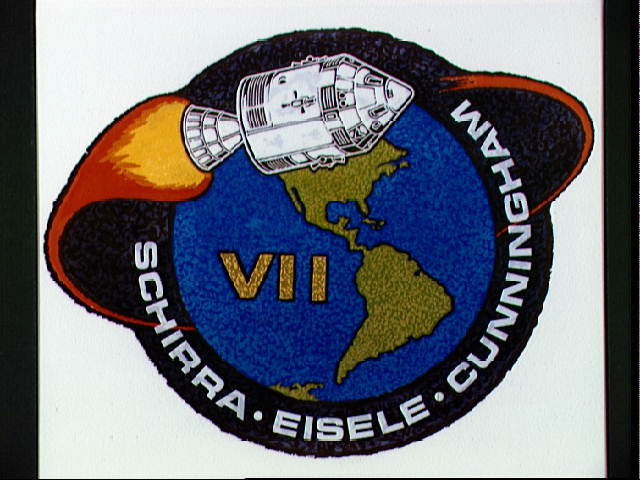
When Grissom and his crew were lost in the January 1967 pad fire, the planned missions were grounded pending the investigation and crewed launches of the Block I spacecraft were terminated. In May 1967, Schirra, Eisele and Cunningham were named to fly the new first crewed mission, now designated Apollo 7, in 1968. They were to complete a mission of up to 11 days in Earth orbit to qualify the Block II CSM for orbital operations.
The original designations for the crew of Command Pilot, Senior Pilot and Pilot were changed from this flight to reflect each astronaut's role more clearly. These became Commander (CDR), CM Pilot (CMP) and LM Pilot (LMP). For Apollo 7, Cunningham would be the LMP with no LM to fly as the mission was a CSM-only test flight.
Recovering from Tragedy
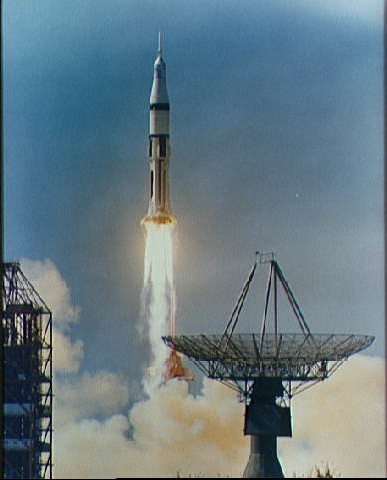
The launch from Pad 34 on 11 October 1968 was also the first crewed flight of a Saturn 1B. This rocket was uprated from the uncrewed Saturn 1 but was far less powerful than the Saturn V moon rocket. The Saturn 1B was planned for use in Earth orbital missions in support of Apollo and what were then termed Apollo Applications missions (later renamed Skylab).
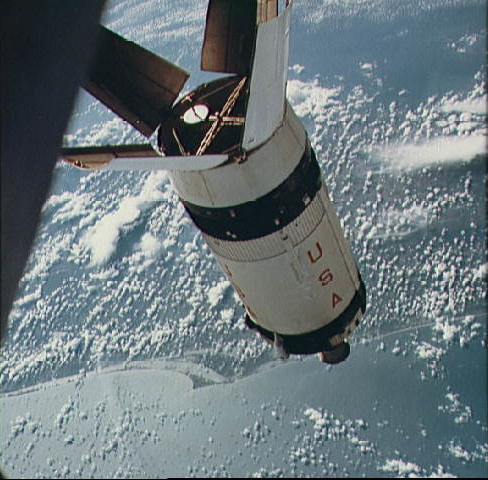
The ascent was without incident and the crew quickly adapted to the increased volume inside the Command Module (CM) compared to the cramped confines Schirra had experienced on both Mercury and Gemini. One of the early objectives of the mission was to rendezvous with the S-IVB stage which, on later missions, would house the Lunar Module (LM) inside a protective adapter section. During the station-keeping exercises with the stage, it was noted that one of the adapter panels had not fully retracted. On future missions these panels were to be jettisoned to prevent them hindering docking operations with the LM.
Test objectives would take up most of the crew's time once they were safely in orbit. Due to the requirement to ensure maximum return from Apollo 7, the major objectives had been pre-planned to occur as early in the flight as possible and by the end of the second day the crew had accomplished over 90% of the pre-mission goals. There were still eight days remaining in the mission.
With this flight, Schirra became the first - and only - NASA astronaut to fly on all three pioneering US human space programmes, Mercury, Gemini and Apollo. He also became the first person to fly three separate missions. Schirra had wanted to name his spacecraft Phoenix to reflect the rising of the space programme from the ashes of the Apollo 1 fire, but NASA refused. Each of the Mercury capsules had been named (Schirra called his Sigma 7) but not the Gemini spacecraft. When both the CSM and LM were flown together from Apollo 9 onwards it was necessary to distinguish the two spacecraft in communications, so NASA authorised the naming of each by the crew. This continued until Apollo 17 and was later revived with the naming of the Space Shuttle orbital vehicles
The Wally, Walt and Donn Show
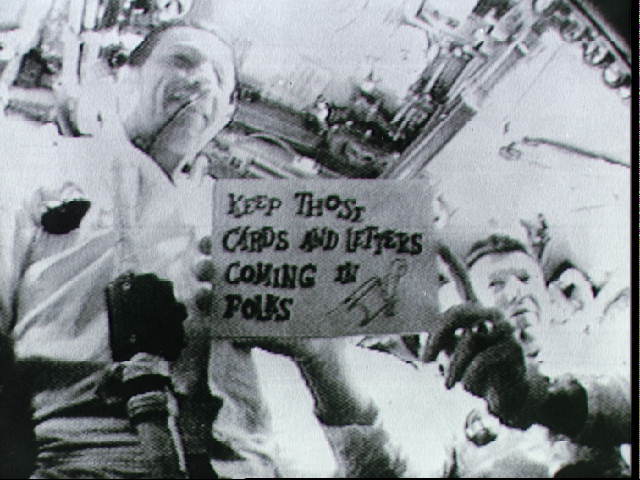
A feature of Apollo 7 was the first live TV transmissions from an American spacecraft. There were seven broadcasts during the mission and the crew clearly enjoyed the shows, displaying cards such as "From the lovely Apollo room high atop everything". Viewers were treated to demonstrations of the effects of microgravity on food, liquids and equipment as the crew conducted guided tours of their spacecraft.
101% Success
During the mission, the crew completed eight firings of the Service Propulsion System (SPS) at the rear of the Service Module (SM). This was the main engine of Apollo and would be used for major manoeuvres during the missions, insertion into and out of lunar orbit and for de-orbit burns on Earth orbital flights. The longest of these burns on this flight lasted for 66 seconds and briefly allowed Apollo 7 to reach an altitude of 430 km (267 miles). In addition to the engine burns and systems tests, the crew also conducted an extensive range of weather and terrain photography using the Hasselblad Model 500C 70-mm still camera. A total of 500 photos were taken of land and ocean areas, of which 200 were usable. The challenge of changing film magazines, filters and settings contributed to the poor quality of the other 300 frames. Terrain images of the United States, Mexico and the Middle East were captured, as well as extensive photography of the islands in the Pacific Ocean, northern Chile and across Australia. Of the 500 weather photos, about 300 showed cloud formations and other items of interest, with a further 80 showing oceanographic topics of interest. Pacific atolls, Caribbean islands, Australian reefs, climatic and hydrology topics were focused upon, as well as the tropical storms Hurricane Gladys and Typhoon Gloria. Overall, the mission was termed as being 101% successful.
Head Colds
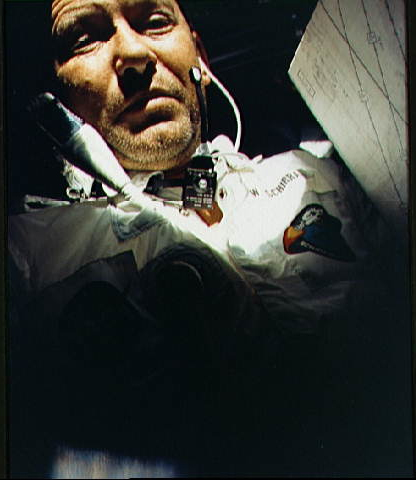
Unfortunately, Apollo 7 is mostly remembered for the cold suffered by Schirra during the mission and the irritable exchanges between him and the ground as a result. Schirra caught the cold shortly before launch. Despite numerous reports in the media, Eisele and Cunningham never did get colds, although they did experience similar symptoms. Despite medication the symptoms persisted and blocked ears and noses are uncomfortable in microgravity. Schirra cancelled a TV transmission and was irritated that two burns and other activities were added to the crew's workload.
When Schirra indicated they would return to Earth without wearing their pressure helmets, this prompted further discussions. But they did come home without helmets and gloves and with no adverse effects. Ironically, Schirra later participated in TV commercials for a leading cold remedy.
Back on Earth
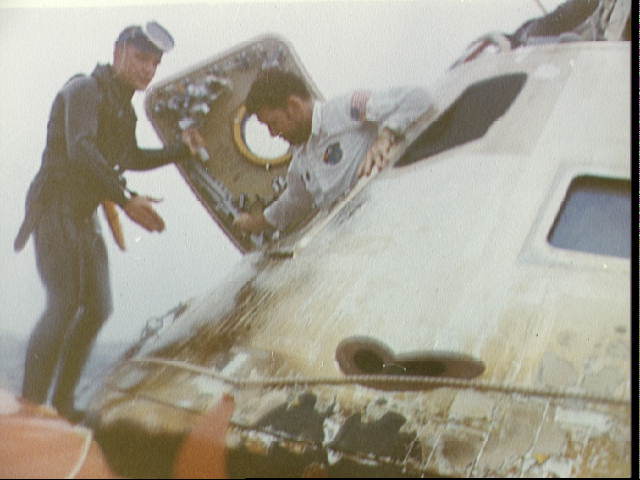
After completing 163 orbits of Earth, Apollo 7 splashed down on 22 October 1968 in an apex down (Stable II) position. Within a few minutes, inflatable bags righted the CM to Stable I. The crew were none the worse for their ordeal. Apollo 7 was successful in every respect, with all systems operating as designed. All but one of the objectives were met and the flight clearly qualified the vehicle for operations in Earth orbit. It was now time to demonstrate the CSM's performance at lunar distance. That would be the objective of the next mission - Apollo 8 and the first flight to the Moon.
After Apollo 7
None of the three astronauts would fly in space again. Some say this was an after effect of Schirra's comments and actions as a result of his cold. In fact, Schirra had planned to retire from NASA after the flight and did so in 1969, entering a new career of financial investments and business management. He died in May 2007 at the age of 84. Donn Eisele served on the back-up crew for Apollo 10 before being reassigned to Langley Research Center in Virginia. He left NASA in 1972 to pursue a business career, but died in 1987 aged just 57. Walt Cunningham was assigned to the Skylab programme but was not chosen to command a mission. He left NASA in 1971 to begin a successful career in investment management. He died in January 2023 at the age of 90.
The crew were awarded the NASA Exceptional Service Medal for their achievements on this mission. But it was not until October 2008 - 40 years later and, in the case of Schirra and Eisele, posthumously - that they finally received the agency's highest award, the Distinguished Service Medal, which had been awarded to all the other Apollo crews shortly after their missions.
This mission report is copyright Astro Info Service Limited, 2026
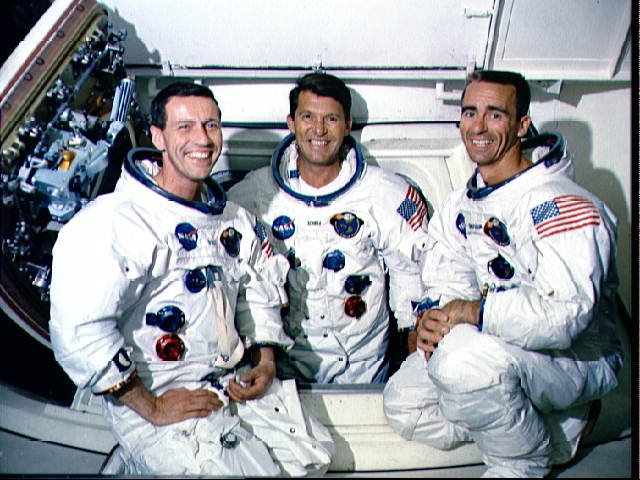
During training for their mission, the Apollo 7 crew pauses for a group photograph. (L to r) Donn Eisele (Command Module Pilot, CMP), Wally Schirra (Commander, CDR), Walt Cunningham (Lunar Module Pilot, LMP). Image courtesy of NASA.
Apollo 7 launches on a Saturn 1B rocket on 11 October 1968. This first crewed flight following the tragic Apollo 1 fire was vital to the recovery of the Apollo programme and its goal of a landing on the Moon by the end of the decade. Image courtesy of NASA.
An important early objective for the mission was to rendezvous with the S-IVB stage of the rocket, which would house the Lunar Module (LM) on later missions. The adapter sections can be seen in open configuration, but were deemed likely to interfere with docking operations and would be jettisoned on missions carrying the LM. Image courtesy of NASA.
During the first of seven live TV broadcasts from the mission, Donn Eisele (left) and Wally Schirra (right) can be seen holding up a hand-written "Keep those cards and letters coming in folks" cue card to the camera. These broadcasts had to be timed to occur over ground stations in Texas and Florida, the only ones with the equipment to receive the signals from the spacecraft and convert them into a format for broadcasting. Image courtesy of NASA.
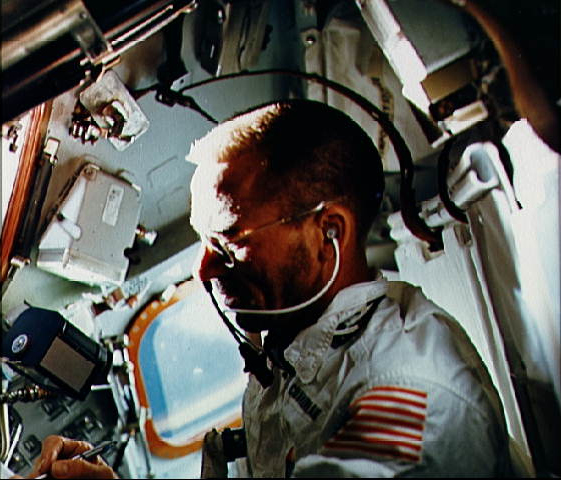
LMP Walt Cunningham is photographed writing with a space pen while performing a flight task on Flight Day 9 (FD 9) of the Apollo 7 mission. Image courtesy of NASA.
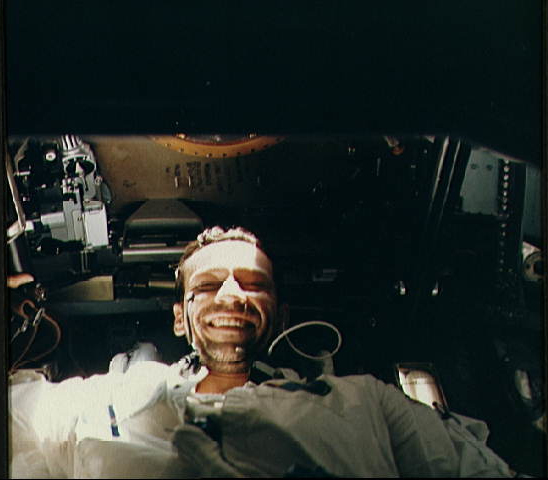
Command Module Pilot Donn Eisele takes a moment to smile for the camera during the flight. This image was taken during FD 9, by which time the astronaut was sporting a heavy beard growth. Image courtesy of NASA.
Mission Commander Wally Schirra was ill with a head cold during the flight, as can be seen in this image of a tired looking astronaut taken late in the mission. His condition led to some irritable exchanges by the commander with Mission Control. Image courtesy of NASA.
Wally Schirra climbs out of the Command Module following splashdown at the end of the Apollo 7 mission, assisted by a navy diver. The crew had returned without wearing their suit helmets over concerns about their eardrums due to sinus pressure from their head cold symptoms. Schirra had exercised his 'Commander's right to have the last word' to overrule the opinion of those on the ground. Image courtesy of NASA.